Thursday, February 7, 2013

Apache Maintenance: Monthly Checklist


Just as important as your daily and weekly maintenance routines, your monthly Apache upkeep is essential to keeping repair costs low and avoiding the unexpected break downs when your time in the field is so important. In addition to the daily and the weekly checklists, check out what else you should be maintaining:

Adjustable axles

Torque the axle bolts to prevent the male axle tube from moving in the center axle. Adjust the on-the-go axle bolts to 18 pounds and the manual adjustable axle bolts to 80 pounds. This maintenance routine is only required on the adjustable axles.

Axle bolts

Deflection from the wheels on hillsides put added stress on the dropbox to axle bolts and the planetary to axle bolts. This makes it important to check both. Torque the dropbox to axle bolts to 260 pounds, and torque the planetary to axle bolts to 140 pounds. 

Check the hydraulic filter

The indicator on the hydraulic filter can be seen from the right side of the machine if you are standing to the right rear of the cab. The green section on the hydraulic filter indicator shows that it has plenty of capacity, but the red section indicates that the hydraulic filter needs changed. To properly check the filter, make sure the machine is running before you perform this maintenance check. 

Clean the radiator

The 2012 and 2013 models are equipped with reversible engine fans. To clean out the radiator, start the machine and step outside to the left rear corner of the engine and locate the switch by the batteries. It is a momentary switch so you need to press and hold the switch in. This will make the fan stop, reverse rotation and then speed up to blow debris from the radiator.


Air Intake Filters

The Apache has a sensor on the engine that will alert you on the console screen when there is an air intake restriction, but it is a good idea to check the air filter on a monthly basis. To do this, tilt the hood to access the air filter. Here is a video on more detailed instructions.


The cab air filters need attention too; however, they are often the most neglected filters. Clogged filters will decrease the air conditioner’s performance and air quality in the cab, so take the time to perform monthly checks on the cab air filters and change if necessary. 

For access to the cab air filters, remove the screws on the rear panel and remove the panel for access. Look for both the charcoal filter and the recirculation filter and replace when necessary.


Inspect booms

Take a moment to inspect the booms for damage before you leave for the fields. Repairs are much easier in the shop. Also, pressurize the wet system with water to check for any leaks that could cause a problem in the field. Inspect the wet system hoses from the pump to the booms for rub points and soft spots resulting from use and weather. Replace as needed. 

While you are inspecting for leaks, a quick check of the hydraulic hoses on your Apache could help you catch any potential catastrophes resulting from hydraulic failure on the sprayer. Look for rub points on the hoses and fittings and check for any hoses on the boom that could get caught in a pinch point when folding. 

Following a regular maintenance program will keep you out of the shop and in the fields when it matters most. Here is a monthly maintenance checklist for your Apache 20 Series to help ensure you don’t forget an important step. If you are operating an older Apache model, additional or different maintenance will be required.


Tuesday, February 5, 2013

Conservation programs suffer in 2013


The extension of the Farm Bill has done little to ease the minds of farmers, and has done even less to support conservation programs. While a handful of programs were extended through the Agricultural Appropriations Act for Fiscal Year 2012, many programs are greatly affected by the extension.  

Source: http://www.nrcs.usda.gov/wps/portal/nrcs/main/national/programs/farmbill/

The Farm Bill extension keeps conservation programs in existence on paper even if there is a lack of funds to continue the programs. For now, many of these programs have no mandatory funding and are left to discretional funding. 

The Land Trust Alliance, an organization that partners with the Natural Resources Conservation Service, states that easement programs have lost $500 million of funding from the baseline due to cuts from mandatory funding. Easement programs include the Farm and Ranch Lands Protection Program, the Grassland Reserve Program, the Healthy Forests Reserve Program and the Wetlands Reserve Program. 

One of the Farm Bill’s largest conservation programs, the Conservation Stewardship Program (CSP), is facing many struggles in 2013. The CSP is designed to reward farmers who make environmental improvements to their land; however, the extension has severely limited the number of acres the program can enroll. 

According to an article written by the American Forests Organization, “The Conservation Stewardship Program (CSP), for example, is currently working on projects across the country on approximately 50 million acres of land and was authorized to enroll an additional 12.8 million acres in 2013 under the 2008 Farm Bill… enrollment has been reduced to only one million acres in 2013.” 

Source: http://www.americanforests.org/blog/fighting-for-the-farm-bill/

Some of the conservation programs were authorized through the continuing resolution and are guaranteed until 2014; however, these programs only have enough funding to manage the existing projects. Environmental Quality Incentives Program, Wildlife Habitat Incentives Program, Agricultural Management Assistance Program and the Farmland Protection Program are among the programs extended until 2014. 

To learn more about which programs are still available in your area, contact your local National Resources Conservation Service office.

Friday, February 1, 2013

Apache Maintenance: Weekly Checklist


In addition to the daily checklist, your Apache 20 series also needs further maintenance checks on a weekly basis. Regular maintenance on your self-propelled sprayer will help prevent downtime in the fields. 

Re-torque the wheel lug nuts and boom lead bolts 


Starting with the wheel lug nuts, check the torque of the rear wheel lug nuts. The rear wheels are large and can have deflection that can possibly work to loosen the lug nuts. Additionally, hillsides exert a large force on the wheels especially when loaded. Torques should be set at 420 pounds on both the front and rear wheels.


It is important to re-torque the boom lead bolts to 420 pounds as well in the first hours of operation after the powdercoat on the brackets has had time to settle in. This is called the boom adjustment clevis.


Important points to grease


Start with the steering components, it is important to grease the tie end rods on the cylinders because a lack of grease can cause premature wear which can cause erratic steering. On the other hand, do not over grease or you can blow out the rubber boots. Beyond this, greasing the kingpins will prevent them from binding in the axle tubes. Additionally, if they are left unattended, they will require more hydraulic pressure from the steering motor that can cause a chatter in the steering system. Also, the center pivot bushings will require a weekly grease to extend the life expectancy.


Check Differential Fluid Level


While it is important for the differential to have an adequate amount of fluid, it is also important not to overfill the differential. Too much oil can cause the differential to run hot enough to push oil out of the vents. The vents should also be inspected to make sure air is able to move in and out of the differential with temperature changes. 

Re-Phase Steering Cylinders


To re-phase the steering cylinders, turn the wheels to the right and continue to turn the steering wheel after the wheels stop turning. This will allow oil to purge the system. Then repeat this process on the left side. You may need to move the machine forward to extend or retract the cylinder fully, unlock the steering wheel. Then continue turning the steering wheel 10 revolutions to the left which allows the oil to finish the re-phasing procedure.  Re-phasing the steering cylinders on the adjustable axles will remove air from the system on adjustable axle machines that could cause the wheels to toe in.


Adjust Poly Tank Straps


Since wet straps can stretch and may cause the tank to loosen up, it is important to readjust the poly tank straps weekly. Tighten straps as much as possible because loose straps can cause the tank to shift. We recommend doing this adjustment with 250 gallons of water in the product tank. 


Grease Driveline


Greasing the driveline will keep the slip yoke from slipping and this will prevent the carrier bearing from being forced out of the holder. Beyond this, greasing the driveline will prevent wear on the driveshaft which could cause chatter. 


Boom Adjustments


Regular boom adjustments are crucial to the longevity of your booms because keeping the boom in adjustment will prevent it from breaking. The sway adjustment bolts should maintain a credit card thickness gap between the wear strip and one of the steel tubes at each of the 4 corners. The breakbacks should be straight with the rest of the boom. The tip fold cylinder linkage should have very slight movement from side to side.

Additional Equipment


If you have added features on your Apache, such as foam markers, then additional weekly maintenance will be needed. Using the rinse tank water, clean the foam marker parts. Also, take time to clean the strainers because they could burn up the pump if they are not properly maintained.
Just as important as daily maintenance checks, weekly maintenance is a key component to preventing costly repairs. This weekly checklist is designed for the 20 series Apache, and older models may need additional maintenance.


Monday, January 28, 2013

Nozzle Troubleshooting


One of the lowest cost items on your sprayer has the potential to waste the most money. Spray nozzle difficulties can result in a number of more serious issues such as spray drift, over application and distorted spray patterns. Ultimately nozzle troubles take away from your bottom line. 

Before taking your sprayer out in the fields, it is important to check for spray uniformity among all of the nozzles. This can easily be done by spraying water on a concrete surface and observing the drying patterns. If the nozzle produces excessive accumulation in the spray pattern, a variety of minor problems could be occurring such as nozzle wear, low boom height, low operating pressure or too much nozzle spacing. 

Check manufacturer recommendations on boom height, nozzle spacing and operating pressure to assure you are operating at the optimal conditions. 

Irregular spray patterns can result from other sources as well including clogged nozzle tips, mismatched nozzles, uneven booms and uneven pressure consistency along the boom. Restrictions in the spray hose or a spray hose that is too small, in terms of diameter, may cause noticeable pressure differences. To check for pressure differences, it is recommended to use an accurate, quality pressure gauge. 

Never use different nozzles across the boom as this can result in uneven spray patterns and a lack of coverage or over application. If a nozzle becomes clogged, it is best to blow out the dirt with a soft-bristled brush or compressed air; you should never try to blow it out with your mouth or clean with wire because the orifice can easily be damaged. Once you have determined that the pressure is even, the booms are level and all of your matching nozzles are unclogged, if you are still seeing irregular spray patterns, it may be time to replace the nozzle tips. 

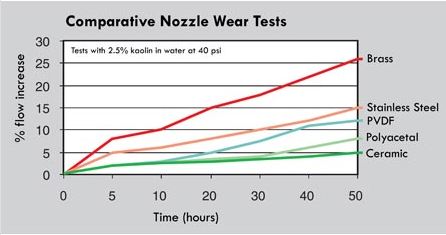
Inaccurate applications due to nozzle wear can waste chemicals and money, making it important to evaluate the nozzle tips. Worn nozzles produce increased flow rates resulting from an increased nozzle orifice area. It is recommended to replace nozzles if the flow rates are 10 percent or more in error. 

The nozzle material is a major contributing factor to the rate of nozzle wear. Nozzle tips come in an assortment of materials including nylon, brass, stainless steel, thermoplastic, tungsten carbide and ceramic. Generally, nozzle tips manufactured from nylon or brass will wear out much quicker than ceramic, tungsten carbide and thermoplastic. Thermoplastic nozzles are noted for their resistance to harsh materials, but they are also known to swell with some chemicals. Stainless steel nozzles will typically produce a more uniform pattern over a more extended period of time. 

Source: http://www.hpro-eu.com/NR/rdonlyres/5C8BFEA9-2D63-4E6C-BDB0-96AEF92B450D/2564/Nozzleweartestschartsqu.jpg
 
Nozzle wear is also affected by the abrasiveness of the chemicals used for application. More abrasive substances will wear down nozzle tips much quicker than less corrosive chemicals. 

Ultimately, achieving spray uniformity will cut down on non-target contamination and minimize overuse of chemicals allowing you to achieve the most effective spray application. Regular maintenance and checks on spray nozzles will result in more accurate, precise applications in the field. 


Sprayer calibration is essential to checking spray nozzles and their spray patterns. To assist with sprayer calibration, a variety of calibration products are available including the Spot On sprayer calibrator, SpotOn mini-patternator and Hypro calibration jugs. The sprayer calibrator can assist you with choosing a nozzle and finding worn nozzles. The mini-patternator will help you visualize your spray pattern and spray coverage.

Friday, January 25, 2013

Existing Farm Bill here to stay, at least for another nine months

The Farm Bill was extended in a last minute effort to avoid reverting back to the 1949 Farm Bill. This extension did not include farm policy reform but rather gave Congress a deadline of September 30, 2013 to decide on new policy.

In the meantime, a majority of the 2008 Farm Bill legislation was extended minus a number of conservation and disaster relief programs that lack funding. This means that even though the programs are on the books, there is no additional funding to carry out the programs.

Conservation, disaster and emergency assistance programs have drawn the short straw in terms of funding. Many of these programs lost their mandatory funding and now receive only discretionary funding which is allocated by Congress. 

While neither the Republican side nor the Democrat side seem particularly pleased with the Farm Bill extension and a majority expressed interest in abandoning the direct payment program, the extension seemed to be the only last minute option to solve the so-called “dairy cliff” problem.

On the other hand, a significant change that came from the last minute legislation involves the estate tax that was set to revert back to 55% tax on estates valued over $1 million. Instead, with the extension, the rates rise from 35% to 40% for estates valued over $5 million. This is important to farmland estates since a few hundred acres can quickly max out the exemption.

Section 179 and Bonus Depreciation are back for one more year!


With higher deduction limits of $500,000, Section 179 has boosted its previously set limits in 2012 for the 2013 tax year. Additionally, the higher deduction limit of $500,000 will work retroactively for the 2012 tax year which was previously set at $125,000.  

Equipment purchases made in 2012, including sprayer purchases, can use the new deduction limit instead of the original $125,000.

As a reminder, the Section 179 deduction is available for use on most new and used capital equipment; however, the additional bonus depreciation is only available for us on new equipment. The bonus depreciation allows for an additional 50% tax deduction beyond the Section 179 deduction. Typically, to calculate the total deduction, start with Section 179 and then add in the bonus depreciation. The exception to this rule is when the business has no taxable profit in the given tax year.